
DBT Basics
What Is a DBT Diary Card (And Why It Matters)
DBT diary cards help therapists and patients track emotions and skill use daily. Here's how they work and why they're central to DBT treatment.
March 25, 2026 · Dbrief Team
Dialectical Behavior Therapy (DBT) was developed by psychologist Marsha Linehan in the late 1980s to treat borderline personality disorder. Since then, it has expanded to address a wide range of conditions including depression, anxiety, eating disorders, and PTSD. At the heart of every DBT treatment program sits one deceptively simple tool: the diary card.
What Is a DBT Diary Card?
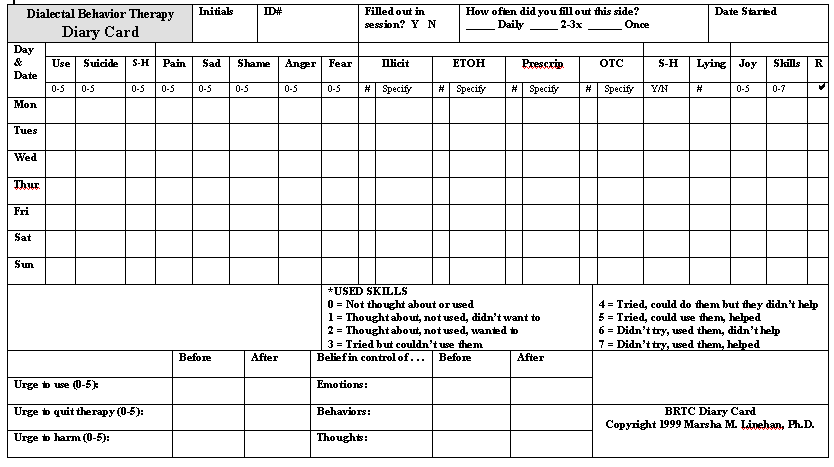
A DBT diary card is a daily tracking form that patients complete between therapy sessions. It captures information across several dimensions:
- Target behaviors — actions or urges the patient is working to reduce (self-harm, substance use, impulsive behaviors)
- Emotions — daily ratings of feelings like sadness, shame, anger, fear, and joy on a 0–5 scale
- Skill use — whether the patient used specific DBT skills that day (mindfulness, distress tolerance, emotion regulation, interpersonal effectiveness)
- Medication compliance — whether prescribed medications were taken
The card creates a continuous record of how a patient is doing between sessions, giving the therapist critical data to guide treatment.
Why Diary Cards Matter in DBT
DBT is structured therapy. Sessions follow a hierarchy: life-threatening behaviors are addressed first, then therapy-interfering behaviors, then quality-of-life issues. The diary card is the mechanism that makes this hierarchy work in practice.
Without accurate daily data, therapists are forced to rely on memory — both their own and their patient’s. But memory is unreliable. The past week gets compressed into whatever was most salient: the argument on Tuesday, the good day on Friday. The quieter days, the slow emotional build-up, the nights where skills were or weren’t used — these get lost.
The diary card prevents this by creating a granular day-by-day record. A therapist can look at a completed week and immediately see: there were three high-distress evenings, skills were used twice, and there was an urge on Thursday that wasn’t recorded until just now in session.
The Problem With Paper Cards
The traditional diary card is a paper form. Patients fill it out (or are supposed to) and bring it to their next session. In practice, this system breaks down in predictable ways:
Patients forget to fill them out. It’s easy to skip a day, then skip two, then realize on the morning of your therapy appointment that the card is blank. Many patients fill out the whole week in one sitting right before their session, relying on memory — precisely what the card is designed to prevent.
Cards get lost. Paper moves through the world unpredictably. It gets left at home, forgotten in a bag, thrown away by accident.
Therapists have no visibility between sessions. A patient could be in crisis on Wednesday and the therapist won’t know until Friday. The card, even when faithfully completed, only communicates at the session boundary.
Data isn’t aggregated. A paper card gives you one week’s data. Seeing trends across months, identifying seasonal patterns, comparing before and after a medication change — none of this is practical with paper.
What a Modern Diary Card Looks Like
Digital diary card systems address these gaps by moving completion to the patient’s phone and transmission to real-time. The core improvements:
Daily SMS reminders prompt patients to complete their card each evening, dramatically improving completion rates compared to paper.
Real-time dashboards let therapists see how patients are doing between sessions. A spike in distress on Wednesday can prompt an outreach call rather than waiting until Friday’s session.
Trend analytics surface patterns that would be invisible in weekly paper reviews: emotional valleys that correlate with specific days of the week, skill use declining over time, medication compliance patterns.
Automated alerts flag clinically significant events — high distress scores, self-harm urges — so therapists can respond before situations escalate.
How Dbrief Approaches This
Dbrief was built specifically for DBT practices. Rather than adapting a generic health tracking app to the DBT use case, we started from the therapy structure itself.
Each patient has a customized diary card configured by their therapist, tracking the specific target behaviors and skills relevant to their treatment. Daily SMS reminders go out each evening. Completed entries flow into the therapist’s dashboard immediately. Alerts surface automatically for high-risk entries.
The goal isn’t to replace the therapy session — it’s to make the sixty minutes between a therapist and a patient as productive as possible by ensuring both parties arrive with accurate, complete data about the week that just passed.
For DBT to work as designed, diary cards need to work. That means making them easy enough that patients actually complete them, and delivering the data to therapists in a form they can act on. Paper cards, in most practices, fail this test. That’s the problem Dbrief exists to solve.
Further reading:
- Linehan, M. M. (1991). Cognitive-behavioral treatment of chronically parasuicidal borderline patients. Archives of General Psychiatry, 48(12), 1060–1064. — The original RCT that established DBT’s evidence base
- DBT-Linehan Board of Certification — Certification standards for DBT clinicians and programs
- NAMI: Dialectical Behavior Therapy — Patient-facing overview of what DBT involves
- Behavioral Tech — Training resources from Linehan’s institute